STEP 01
Tap start, set your interval.
50 mm by default, or 100 mm. A quick calibration confirms your phone is hearing each blow cleanly through the site noise.
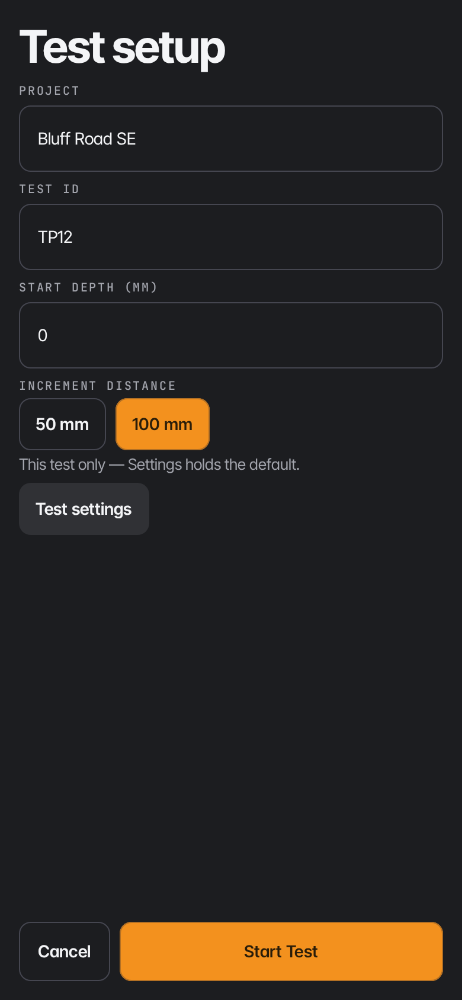
Groundtruth turns any iPhone or Android device into a hands-free DCP recorder. Drop the rod, start the test, swing the hammer — every blow lands at the next depth increment, and you can export a clean CSV or a full PDF report before you leave site.
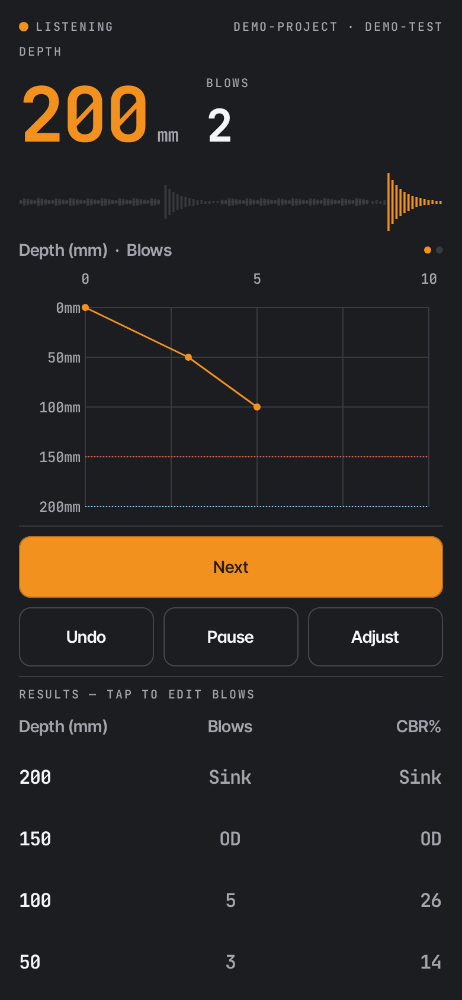
The whole loop runs in your hand. No tablet, no rugged case, no wired sensor — just the rod and the phone you already carry.
50 mm by default, or 100 mm. A quick calibration confirms your phone is hearing each blow cleanly through the site noise.
Blow detection runs entirely on-device. Each strike lands at the next increment with sub-second latency, and the phone speaks the new depth back so your eyes stay on the rod. Double-tap to advance, triple-tap to pause — gloves on. Overdrill and sink are one tap each.
Edit any blow, then email a clean CSV — or generate a PDF report with a satellite site map and CBR plots — before you walk back to the truck. Your test data stays stored on-device.
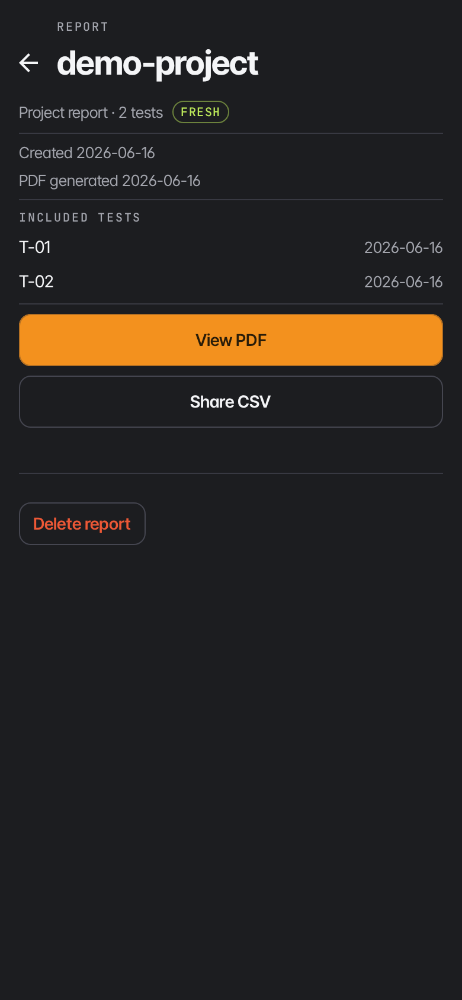
Groundtruth today is one job done well: dynamic cone penetrometer tests, captured by ear. The roadmap is wide open — and shaped by the engineers using it.
Field-grade ground truth for the engineers, surveyors and crews whose hands are full and whose pencils get muddy.
One engineer, one rod, one phone. No tablet, no laptop in the truck.
Run the test, send the report, invoice the client — same afternoon.
Consistent depth logs across every operator. No more arguing over handwriting.
Projects keep every test organised today. (Coming soon) team sync and auto-classification.
Recording is free and unlimited. Every account gets 5 data exports (CSV, PDF). Upgrade to a paid plan to allow unlimited exports.
$5 regular monthly price
$2.50 NZD / month
50% off Launch discount
Billed monthly.
$60 12 months paid monthly
$48 20% off vs. monthly
$24 NZD / year
50% off Launch discount
Billed yearly. Launch discount applies to the regular yearly price.
$96 NZD one-time
Pay once, keep it forever. Full price; no launch discount.
$4 regular monthly price
$2 AUD / month
50% off Launch discount
Billed monthly.
$48 12 months paid monthly
$39 18.75% off vs. monthly
$19.50 AUD / year
50% off Launch discount
Billed yearly. Launch discount applies to the regular yearly price.
$78 AUD one-time
Pay once, keep it forever. Full price; no launch discount.
$3 regular monthly price
$1.50 USD / month
50% off Launch discount
Billed monthly.
$36 12 months paid monthly
$28 ≈22.22% off vs. monthly
$14 USD / year
50% off Launch discount
Billed yearly. Launch discount applies to the regular yearly price.
$56 USD one-time
Pay once, keep it forever. Full price; no launch discount.
$4 regular monthly price
$2 CAD / month
50% off Launch discount
Billed monthly.
$48 12 months paid monthly
$39 18.75% off vs. monthly
$19.50 CAD / year
50% off Launch discount
Billed yearly. Launch discount applies to the regular yearly price.
$78 CAD one-time
Pay once, keep it forever. Full price; no launch discount.
£2.50 regular monthly price
£1.25 GBP / month
50% off Launch discount
Billed monthly.
£30 12 months paid monthly
£21 30% off vs. monthly
£10.50 GBP / year
50% off Launch discount
Billed yearly. Launch discount applies to the regular yearly price.
£42 GBP one-time
Pay once, keep it forever. Full price; no launch discount.
€2.50 regular monthly price
€1.25 EUR / month
50% off Launch discount
Billed monthly.
€30 12 months paid monthly
€21 30% off vs. monthly
€10.50 EUR / year
50% off Launch discount
Billed yearly. Launch discount applies to the regular yearly price.
€42 EUR one-time
Pay once, keep it forever. Full price; no launch discount.
Get on the early access list. Run a test on the way back to your desk. Decide for yourself.